



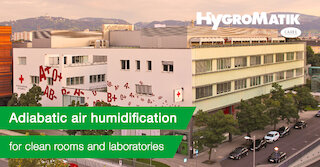
Best practice for adibatic air humidificaiton in clean rooms for Linz Blood Center @

Adiabatic air humidification in clean rooms – maximum hygiene and cost-effectiveness

The Linz Blood Center relies on high-pressure nozzle systems from HygroMatik –
with adiabatic air humidification in compliance with the strictest hygiene regulations for economic efficiency.

The clean rooms used for production purposes at the Linz Blood Center must maintain very narrow climate tolerances and a minimum humidity level. For this reason, and due to the insufficient efficiency of the steam humidification systems previously used in the HVAC center, a more efficient high-pressure nozzle solution from HygroMatik was installed in 2013 after an 18-month test phase. Since then, the adiabatic system has been reliably regulating the air humidity in the clean rooms within the required values, saving on operating and maintenance costs year after year. “We are still very satisfied with our decision to use high-pressure nozzle systems from HygroMatik,” says Lukas Rechberger, current Head of Building Services at the Linz Blood Center. “Maintenance costs and wear and tear on the humidification system are very low. As a result, only the replacement of wear parts has been necessary as part of maintenance and servicing.”

We are naturally delighted that even after more than 14 years of operation (including the test phase), practical experience continues to confirm the economic and technical superiority of our adiabatic humidification systems. But let's start at the beginning . . .
Highest hygiene requirements required

Stem cells and tissue are produced from open materials in Class A to D clean rooms covering an area of 3,500 m² at the blood centre operated by the Upper Austrian Red Cross. The air quality, temperature and humidity must meet strict requirements. Due to the highly sensitive nature of the production activities, these rooms are required by law to meet the highest standards in terms of both plant technology and hygiene.

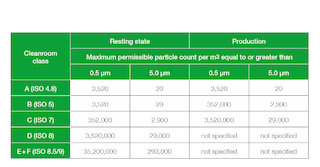
The maximum possible hygiene level is defined in GMP Annex 1. For example, Class B cleanrooms, which serve as the background environment for aseptic preparations for medical devices in Cleanliness Class A, may contain a maximum of 29 particles measuring 5.0 µm per 1 m³ of room air when at rest. By way of comparison, a normal office contains an average of 100,000 particles measuring 5.0 µm in 1 m³ of room air.

Overview of cleanroom categories according to Annex 1 table @

The humidifiers previously used were too expensive

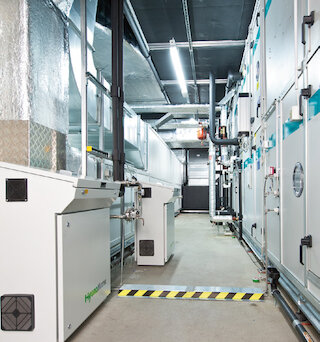
Before the system change, the supply air for the clean rooms at the Linz Blood Centre was treated with eleven isothermal steam humidifier systems. This achieved a relative humidity of 45 percent. These systems were installed in eight air handling units with a maximum air volume of 135,000 m³/h. The maximum output of the eleven steam humidifier systems was 780 kg/h in total.

The systems had proven to be disadvantageous and uneconomical for various reasons, including high operating and maintenance costs and hygiene issues. An alternative to the existing steam humidification system was therefore sought.


Less energy consumption, lower operating costs with adiabatic air humidification

An Austrian engineering firm specialising in electrical and building services engineering and the design of clean rooms in the pharmaceutical sector was commissioned to develop alternative solutions for the unsatisfactory air conditioning and, in particular, air humidification systems.

In particular, the strict legal requirements of ÖNorm H6020 ‘Ventilation systems for rooms used for medical purposes – design, installation, operation, maintenance, technical and hygiene checks’ (2007) had to be complied with. ÖNorm H6020 corresponds to the German DIN 6022 standard, but is more clearly formulated in terms of indoor climate and humidity and is therefore significantly stricter. Until its amendment in 2007, ÖNorm H6020 only permitted isothermal humidification systems for applications in hospitals. The new version of the standard now allows alternative systems to be used if an expert opinion confirms that they are microbiologically and hygienically equivalent to steam humidification.

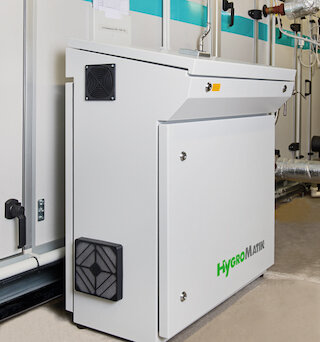
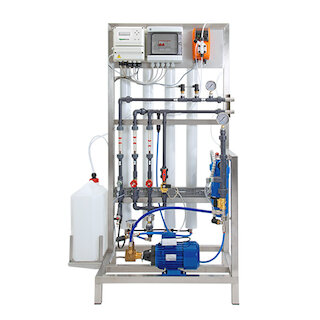
This meant that the use of an energy-efficient adiabatic humidification system could be considered. The engineering firm then developed a water treatment system that works without chemical additives and, together with the HPS (formerly HDS) high-pressure nozzle humidification system from HygroMatik GmbH, forms a complete system that complies with all regulations and standards.

After completing an 18-month test phase, which was supervised by a court-certified expert in hospital hygiene, the Upper Austrian authorities were convinced of the high hygienic standard of the new adiabatic humidification systems. They certified their equivalence to isothermal systems as cited in ÖNorm H6020.

HygroMatik air humidification systems impress the competition

During the test phase, a second adiabatic humidification system from another manufacturer was tested in parallel with the HPS system from HygroMatik for comparison purposes. The evaluation criteria took into account the installation, maintenance, durability and performance parameters of the systems, as well as communication with the respective manufacturer.

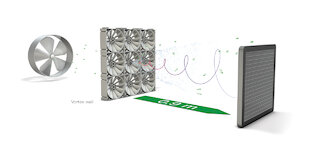
The test results ultimately confirmed the superiority of the HygroMatik solution. Installation of the HPS system (system A) was easier and significantly faster than installation of the competitor's system B. According to the operator, initial signs of wear were detected in system B after the test phase. In contrast, the HPS system continued to function flawlessly. It also impressed with its short humidification distance, low operating costs and almost ‘dry humidification’.

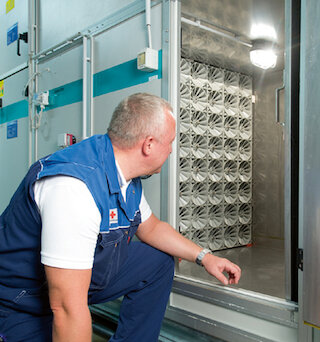
This refers to an almost dry humidification chamber in the air handling unit during humidification. There was no precipitation on the duct walls, except for a small amount of water loss directly at the aerosol separator, which is drained directly. This ideal condition is achieved through the use of precision atomising nozzles and their optimal positioning in the air flow.

When operating HPS systems, the supply air is cooled further without any additional effort. This significantly reduces the energy required for air cooling in the air conditioning system and the necessary output of the water cooling unit.

hygromatik air humidification shortest humidification distance. @

The savings targets were achieved

At the Linz Blood Center, all eleven existing steam humidifiers were converted to eight HPS systems, resulting in annual savings in operating costs. In addition, the operator has equipped two further air handling units with HPS systems, so that a total humidification capacity of 1,100 kg/h can now be used to humidify 158,000 m³/h of supply air.

Conclusion

The complete system described was first used in 2007 with official approval in class A to D cleanroom areas and has since been successfully used in the hospital sector. By combining water treatment and high-pressure nozzle humidification systems, it has been possible to achieve an air quality that complies with legal requirements and can also be proven to be reproducible in ongoing hygiene checks.

Watch list

Send list